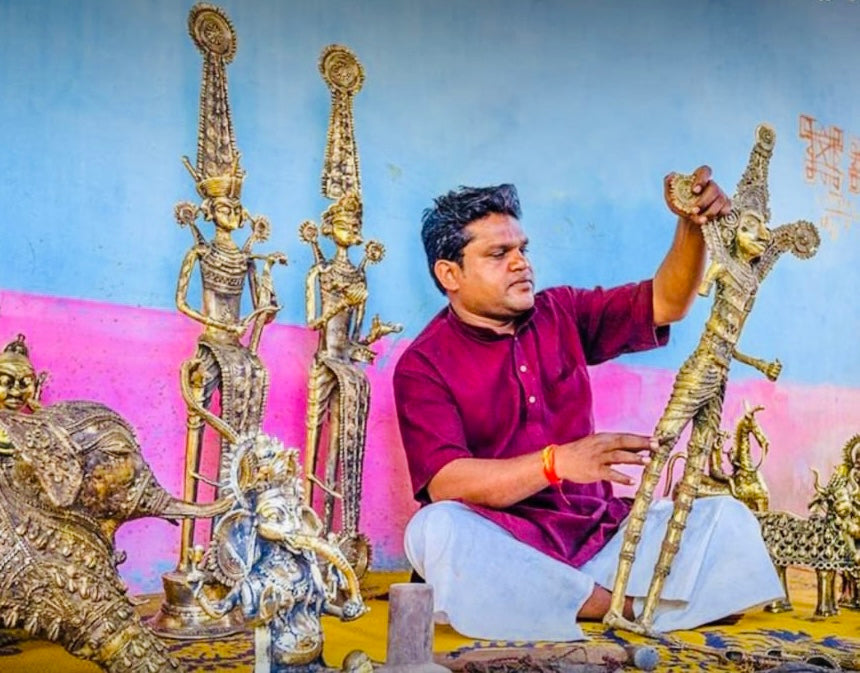
Some art forms survive centuries. Dhokra has survived civilisations. The famous Dancing Girl of Mohenjo-daro, cast over 4,000 years ago, was made with essentially the same technique that tribal artisans in Chhattisgarh and Madhya Pradesh still use today.
The magic of lost-wax casting
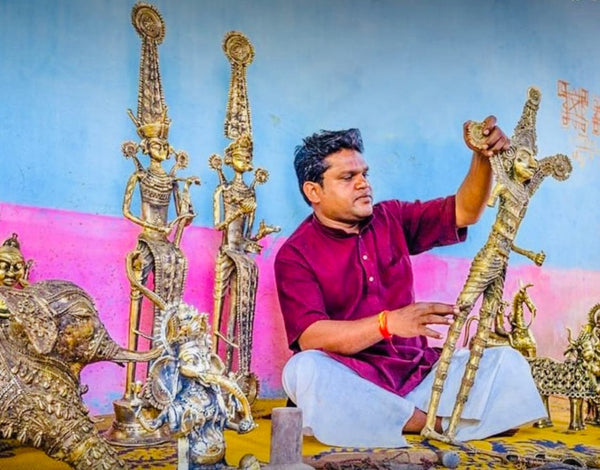
Every Dhokra piece begins as a clay core, wrapped patiently in threads of beeswax. The artisan sculpts every detail, every bangle, every drumbeat frozen in metal, directly in wax. The model is then coated in clay and fired: the wax melts away, and molten brass is poured into the hollow it leaves behind.
Here is the beautiful part: to free the sculpture, the mould must be broken. That means no Dhokra piece can ever be replicated. What you hold is the only one of its kind in existence, and there will never be another.
Stories cast in brass
Dhokra artists cast what they know and love: tribal couples, musicians, dancers, elephants, lamps, and deities. A piece like the Madia Madin tribal couple celebrates partnership in tribal life, while the Dancing Tribal Couple captures music and movement in solid brass. For a striking shelf story, the Cooking Tribal Showpiece set of three brings a whole village scene into your home.
Why it matters
Each purchase directly supports artisan families in Betul and Bastar who have carried this knowledge through generations. In a world of factory sameness, Dhokra is a quiet rebellion: slow, handmade, and impossible to duplicate.
Explore our full Dhokra collection and bring home a piece of living history.