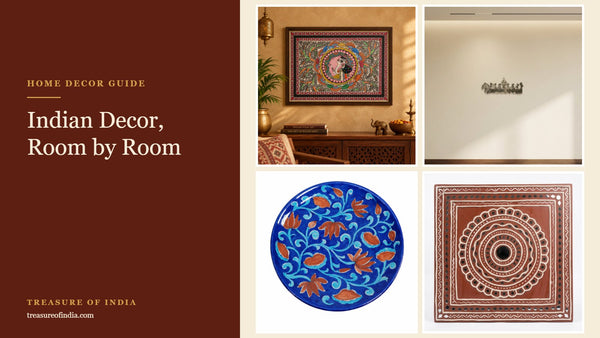

Handmade Indian art can add colour, texture and cultural character to a contemporary interior. The key is to give each artwork enough space to be understood while letting the craft remain the focal point. Here is how to style handmade Indian art, from traditional paintings to sculpture, in a modern home, room by room.
Create a Hero Wall
Choose one larger painting as the main visual anchor and keep surrounding décor relatively simple. Pichwai, Pattachitra, Gond and Rajasthani miniature paintings can each create a different atmosphere depending on subject, scale and colour. As a guide, a painting above a sofa should be about two-thirds of the sofa's width, with its centre at roughly 145 to 150 cm from the floor.

Get the Scale Right
- Leave 15 to 25 cm between the top of a sofa or console and the bottom of the frame.
- If the painting you love is too small for the wall, hang two or three as one group and treat the group as a single shape.
- Before you drill, cut paper to the size of each frame and tape it to the wall. Step back and adjust.
Match the art to the room
- Living room: a large Pichwai or Pattachitra as the focal piece.
- Bedroom: calm subjects such as Radha Krishna, a tree of life or lotus ponds.
- Entrance: Lippan mirror work catches light and welcomes guests.
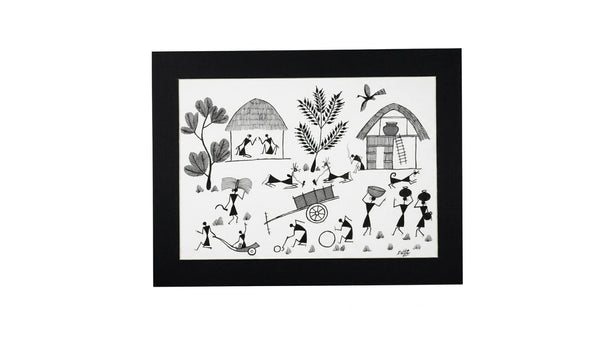
- Study: a single Gond or Warli work for a calm, simple look.
- Prayer room: a Shrinathji Pichwai, a Pattachitra of Jagannath or a carved wooden deity.
Use Dhokra to Add Texture
Handmade Dhokra sculptures work well on shelves, consoles and display cabinets. Group pieces in odd numbers and by visual relationship rather than filling every available space. Explore the Dhokra metal art collection for available sculptures and decorative works.
Pairing rule: put matt next to shine and flat next to raised. Dark brass sits well under a painting with warm reds and ochres. Vary the heights on a shelf.

Bring Gond Art Into Smaller Spaces
Gond paintings can work in studies, hallways, bedrooms and reading corners. Consider pairing artworks by subject or artist while leaving enough wall space around each piece for its details to remain visible. Explore the Gond painting collection for available works.

Build a Gallery Wall
- Pick one link between the pieces: a shared colour, one craft, or one frame finish.
- Start with the largest work slightly off centre, then build outwards.
- Keep gaps even, about 5 to 8 cm between frames.
- Keep the centre of the whole group at eye level, around 145 to 150 cm.
- Mix two or three crafts at most. Gond, Warli and a small Pichwai panel sit together well because each has clear outlines.

Pick a palette that works with the art
Neutral walls in off-white, beige or soft grey let detailed Indian art stand out. Pull one colour from the painting into a cushion, rug or vase to tie the room together. Dark walls, such as deep blue or terracotta, suit gold-leaf Tanjore and Mysore paintings and brass sculpture.
When two artworks share a room, let one lead. Pair a busy, multi-colour painting with a quieter piece in two or three tones, such as white Lippan or a Warli work on a brown ground.
Frame and light it well
- Frame cloth paintings behind glass in humid cities.
- Use a simple wooden frame for folk art; let ornate paintings carry the detail.
- Use warm, indirect light and keep originals out of direct sun.
For paper works, add a mount so the paint does not touch the glass. A warm white LED picture light or a ceiling spot aimed at about 30 degrees cuts glare on glass. Mirror work and brass look flat under even light, so place them near a window or a lamp.

Three Practical Styling Rules
Give the artwork breathing room. Avoid overcrowding a wall or shelf.
Use suitable lighting. Good lighting helps reveal linework, texture and colour.
Choose art with context. Learning about the artist, craft and region can make a piece more meaningful and gives you a stronger reason to keep it in your space.
What Handmade Indian Art Costs
You can start a wall on a small budget. Lippan panels and small wooden panel Pichwai paintings are currently ₹1,599 each. Original Gond paintings currently range from ₹2,599 to ₹1,18,999, and Dhokra pieces from ₹1,190 to ₹49,990. Large Pattachitra paintings shown here currently start at ₹54,999. The site converts ₹ prices to your local currency.
How to Choose Pieces That Last
Buy original, signed work from a named artisan. Every artwork from Treasure of India ships with a signed certificate of authenticity naming the artisan. To check colour and scale before you order, use the "Request a video call" button on the product page. Our guide on buying original Indian folk art online lists more checks.
Care Once It Is on Display
Dust frames and sculpture with a soft, dry cloth. Keep paintings away from direct sun, damp walls, kitchens and bathrooms.
Need help choosing?
Send us a photo of your wall, or see how the art looks in a real space at our gallery in Palam Vihar, Gurugram, which opened in October 2026. Book a visit. For more room-by-room ideas, read our wall painting ideas guide. If you live outside India, see Indian home decor with handmade pieces.
Worldwide Shipping
We ship worldwide from our gallery in Gurugram, India, including to the USA, UK, Canada, Australia, the UAE and Europe. Orders usually arrive in 2 to 3 weeks. International shipping is a flat ₹4,000 per order, so several pieces for one wall can travel together. Within India, delivery is free on orders of ₹2,999 and above and ₹199 below that. Customs duties and import taxes are paid by the buyer; see international shipping, customs and duties. We do not accept returns, except for a piece that arrives damaged; see our returns and refunds policy.
Explore Handmade Indian Art
Browse Indian paintings, discover tribal and folk art, or explore artists and crafts through the Craft Map of India. You can also browse sculpture and artifacts, Warli paintings and Madhubani paintings.
FAQs
How do I decorate a modern home with Indian art?
Pick one hero piece per wall, keep the surrounding décor simple, and repeat one colour from the art in soft furnishings.
Which Indian painting suits a minimal interior?
Gond, Warli and single-motif Pichwai work well in minimal rooms because of their clear forms and calm backgrounds.
Can I mix paintings and sculpture?
Yes. A Dhokra brass piece on a console below a painting adds depth and ties the wall to the room.
How high should I hang a painting?
Keep the centre of the painting, or of the whole group on a gallery wall, at roughly 145 to 150 cm from the floor.
Do you ship handmade Indian art outside India?
Yes. We ship worldwide for a flat ₹4,000 per order. Delivery usually takes 2 to 3 weeks, and customs duties are paid by the buyer.