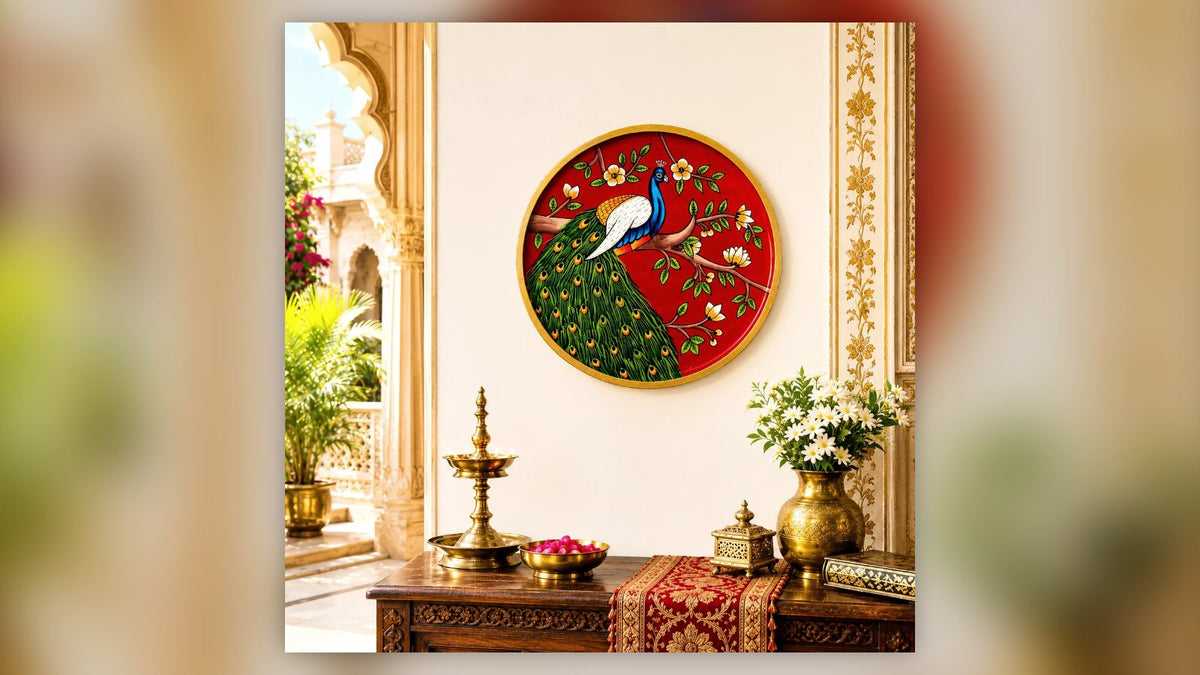
Pichwai is a devotional painting tradition from Nathdwara in Rajasthan, made to hang behind the idol of Shrinathji, a child form of Lord Krishna. The word comes from pichh (back) and wai (hanging). Today Pichwai paintings are collected as fine art and hung in homes, offices and hotels around the world.
Where Pichwai comes from
Pichwai grew up around the Shrinathji temple at Nathdwara, near Udaipur, in the Pushtimarg tradition of Vaishnavism, after the Shrinathji idol was brought there in the 17th century. Temple artists painted large cloth hangings that changed with the festivals and seasons, so the shrine looked different through the year. Families of painters in Nathdwara still practise the craft, often over several generations.
What a Pichwai painting shows
- Shrinathji: the central figure, usually with a raised left arm, dark skin and rich jewellery.
- Cows: Krishna as the cowherd, shown with rows of decorated cows. Cow-only Pichwai, such as Krishna's Divine Cow, are popular for homes.
- Lotus ponds: pink and white lotuses with fish and birds, linked to summer festivals.
- Festivals: Sharad Purnima, Janmashtami, Annakut, Holi and others, each with its own setting and colours.
- Gopis and Raas Leela: Krishna dancing with the gopis of Vrindavan.

Pichwai through the year
- Janmashtami: Krishna's birth, with celebrations in Gokul.
- Sharad Purnima: the autumn full moon and the Raas Leela, in silver and white.
- Annakut: the mountain of food offered after Diwali.
- Holi and Phool Mandali: colours and flower pavilions in spring.
- Summer lotus ponds: cool blues and greens for the hot months.
How a Pichwai is made
The painter starts with a fine cotton cloth, often starched for a smooth surface, and sketches the composition in light lines. Colours are filled in layers using natural and mineral pigments, and details such as jewellery, borders and cow decorations are added with very fine brushes. Many pieces use real gold or silver leaf. A large, detailed Pichwai can take one artist several months.
Types of Pichwai you can buy
- Cloth Pichwai: the classic form, painted on cotton with natural and mineral colours. Sizes run from small panels to 6 ft hangings.
- Antique-style Pichwai: large compositions in the old temple layout, such as the Devotional Shrinathji at 6 x 4 ft.
- Wooden panel Pichwai: painted on wood, for example the Peacock wooden panel.
- Contemporary Pichwai: one motif, such as a single cow or lotus, on a calm background for modern rooms.
How to spot a hand-painted original
- Look closely at the borders and jewellery: hand painting shows tiny variations, a print repeats perfectly.
- Check the back of the cloth: paint often bleeds slightly through a hand-painted work.
- Ask for the artist's name and a certificate of authenticity. Every piece at Treasure of India comes with one.
- Be wary of very large "Pichwai" sold at very low prices. A detailed 5 to 6 ft work can take a painter months.
Popular Pichwai subjects for homes
Most buyers choose one of four subjects, each with its own meaning in the Nathdwara tradition.
Cows and Kamdhenu
Cows stand for Krishna's childhood as a cowherd in Braj, and Kamdhenu is the wish-fulfilling cow of plenty. A cow Pichwai is one of the most popular choices for prayer rooms and entrances. See more cow paintings across crafts.

Lotus ponds
Lotus Pichwais, often called kamal talai, show a pond in bloom during summer. They are calm and work well in bedrooms and living rooms that need colour without a busy scene.

Elephants
Elephants appear in royal processions and festival scenes, and stand for strength and good fortune. A pair of elephants is a common choice for the living room. Browse elephant art in other crafts too.

Peacocks
Peacocks belong to the monsoon scenes of Krishna's life and to Rajasthan itself. Their bright blue and green bring life to plain walls. See peacock art and Radha Krishna paintings across crafts.
Pichwai painting price in India
Pichwai paintings at Treasure of India currently range from ₹1,599 for small wooden panels to ₹1,89,999 for large antique-style Shrinathji works. Price depends on size, detail, materials (gold leaf, natural pigments) and the artist. See current prices in our Pichwai painting collection.
The artists

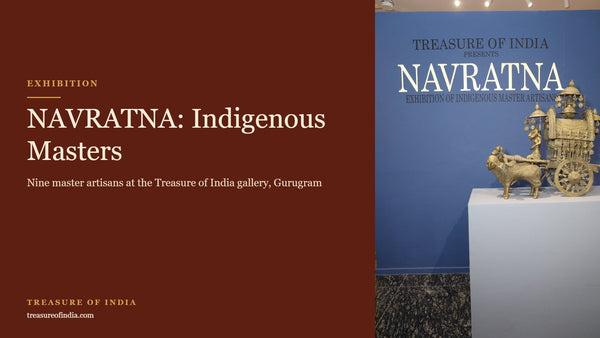
Treasure of India works directly with Nathdwara painters, including master artists Leelakant Pareek and Sudarshan Pareek, both featured in NAVRATNA, the opening exhibition at our gallery in Palam Vihar, Gurugram, in October 2026. Young artist Khushi Parekh paints Pichwai on wooden panels.
Where to hang a Pichwai
A large Pichwai works as the focal wall of a living room or entrance. Smaller cow or lotus panels suit prayer rooms, bedrooms and studies. Keep it out of direct sunlight and away from damp walls. For more ideas, read how to style handmade Indian art in a modern home.
Shipping Pichwai paintings in India and abroad
We ship Pichwai paintings across India and worldwide from our gallery in Gurugram, usually within 2 to 3 weeks. Delivery is free in India on orders of ₹2,999 and above, and international shipping is a flat ₹4,000 per order. Every painting comes with a signed certificate of authenticity. See international shipping, customs and duties.
FAQs
What is the meaning of Pichwai?
Pichwai means "that which hangs at the back". The paintings were made to hang behind the idol of Shrinathji at Nathdwara.
Which state is Pichwai painting from?
Rajasthan. The tradition is centred on Nathdwara, near Udaipur.
Is Pichwai good for beginners to learn?
Simple motifs such as a single lotus or cow are a good start; full temple compositions need years of practice.
What is the price of a Pichwai painting?
At Treasure of India, from ₹1,599 for small wooden panels to ₹1,89,999 for large antique-style Shrinathji works.
Do you ship Pichwai paintings outside India?
Yes, worldwide, for a flat ₹4,000 per order; delivery usually takes 2 to 3 weeks.
Can I see Pichwai paintings in person?
Yes. Our gallery in Palam Vihar, Gurugram shows Pichwai by master artists. Book a gallery visit.