
The tree of life meaning in Indian art is simple and deep at once: a single tree that joins the earth, the sky and every living thing in between. A tree of life painting shows roots, trunk and branches full of birds and animals, and it appears in Gond, Madhubani, Warli, Pichwai and many other Indian crafts. This guide explains the symbolism, how each style draws the tree and where to hang one at home.
What the Tree of Life Means
Many cultures share the idea of a world tree. In India it has its own long history. Hindu stories describe the kalpavriksha, a wish-fulfilling tree that rose from the churning of the ocean. The banyan and the peepal are treated as sacred, and people tie threads around them while making a prayer or a wish. Buddhists honour the Bodhi tree, under which the Buddha is said to have found enlightenment.
In painting, the tree usually carries a few clear ideas:
- Connection: roots in the ground, branches in the sky, linking the world below with the world above.
- Growth and family: branches spreading outward, like generations of one family.
- Shelter and plenty: birds, animals and people living together under one canopy.
- Renewal: leaves, flowers and fruit that return every season.
The Tree of Life in Gond Art
Gond art comes from the forests of central India, mainly Madhya Pradesh. Trees are sacred in Gond belief, and many Gond paintings show the tree as a home for birds, animals and spirits. Artists fill the trunk and leaves with dots, dashes and fine lines, so the tree seems to move. Birds often perch on every branch, which turns the picture into a lively scene of the whole forest.


The Tree of Life in Warli Art
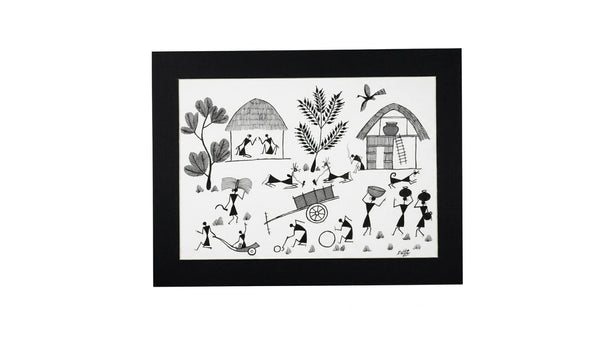
Warli painting comes from the Warli community of Maharashtra. It uses a small set of shapes: circles, triangles and lines, usually white on an earth-red or brown ground. In a Warli tree of life, the tree sits at the centre and stick figures farm, dance and gather around it. The tree becomes the heart of village life, giving food, shade and a place to meet.

The Tree of Life in Madhubani Art
In Madhubani painting from Bihar, the tree is drawn with bold double outlines and filled with bright colour. Fish, peacocks and parrots often sit in or around it. Because fish and peacocks stand for fertility and love, a Madhubani tree painting carries a strong message of family and good fortune. The tree is also a common subject in wedding art.


Trees in Pichwai and Other Crafts
In Pichwai painting from Nathdwara in Rajasthan, the kadamb tree is linked with Krishna. Paintings show him playing the flute beneath it, often with cows and gopis around him. Here the tree marks a place of devotion and divine play.
The tree of life also appears in Lippan mud and mirror work from Kutch, in carved wood and in printed and painted textiles. Hand-painted cloth from India with large flowering trees was once traded widely across the world. Each craft draws the tree in its own way, but the idea of a shared, living world stays the same.
Where to Hang a Tree of Life Painting
- Living room: a large tree painting works well as the main piece on a wall above a sofa.
- Entrance: a tree near the door gives guests a warm, welcoming first view.
- Bedroom: softer Gond or Warli pieces suit a calm space.
- Dining area: a tree full of fruit and birds fits a room for family meals.
Some people who follow Vastu prefer the east or north wall for nature art. This is a popular belief rather than a rule, so choose the wall where the painting looks right and gets good, even light. Keep paper paintings away from direct sun and damp walls.
Tree of Life Painting Prices
Original paintings in our Tree of Life collection currently range from ₹4,999 for a Warli work to ₹6,990 for Gond paintings. Large Madhubani tree paintings by Anita Devi are currently ₹16,990. Price depends on size, detail, the number of figures and the artist.
Shipping Worldwide
We ship worldwide from our gallery in Palam Vihar, Gurugram. Orders usually arrive in 2 to 3 weeks, and international shipping is a flat ₹4,000 per order. Shipping in India is free on orders of ₹2,999 and above. Customs duties and import taxes are paid by the buyer; see international shipping, customs and duties. Every artwork comes with a signed certificate of authenticity naming the artisan, and you can use the Request a video call button to see a piece live on WhatsApp.
Explore More Indian Art
Browse Gond art, Warli art, Madhubani paintings and Pichwai paintings. Read more in our guides to Gond painting, Madhubani painting and wall painting ideas. You can also book a gallery visit.
FAQs
What is the meaning of the tree of life in Indian art?
It stands for connection, growth, family and renewal. The tree links the earth and sky and gives shelter to every living thing.
Which Indian art forms paint the tree of life?
Gond, Warli, Madhubani and Pichwai paintings all feature it, along with Lippan mud work, wood carving and textiles.
Where should I hang a tree of life painting?
The living room, entrance or bedroom. Some people prefer an east or north wall as a Vastu belief, but good light matters more.
How much does a tree of life painting cost?
Paintings in our Tree of Life collection currently range from ₹4,999 to ₹6,990. Large Madhubani tree paintings are currently ₹16,990.
Do you ship tree of life paintings abroad?
Yes. We ship worldwide for a flat ₹4,000 per order, with delivery usually in 2 to 3 weeks.