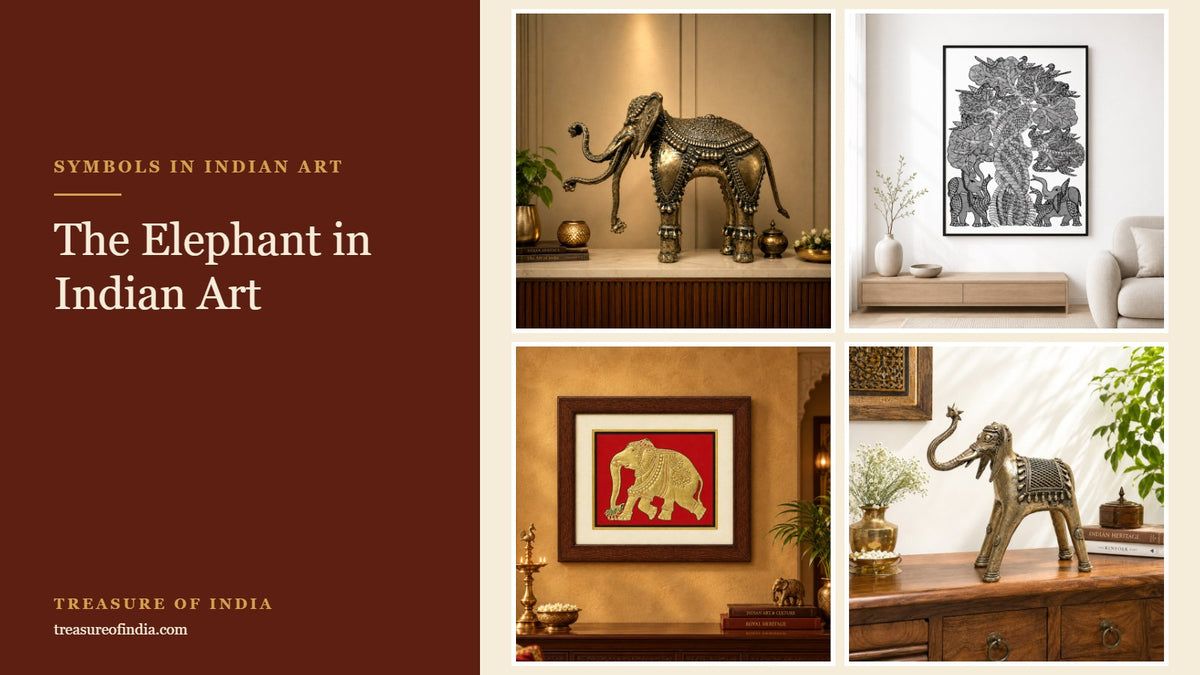
An elephant painting or statue is one of the oldest and clearest symbols in Indian art. Elephants stand for wisdom, strength, royalty and good fortune, and they appear in Gond paintings, Dhokra brass, Pichwai, Mysore painting and many other crafts. This guide explains elephant statue meaning in Indian belief, how each craft shows the animal and what people say about trunk up and trunk down placement.
Why Elephants Matter in Indian Art
Elephants have lived alongside people in India for thousands of years. They worked in forests, carried kings into battle and led temple processions. Over time they became part of religion, royal life and everyday sayings about luck. That long history is why elephants appear in art from the forests of central India to the courts of Rajasthan and Karnataka.
Ganesha: The Elephant-Headed God
Ganesha, the god with an elephant head, is worshipped as the remover of obstacles and the lord of new beginnings. Many Hindu families pray to him before starting a journey, a business or a new home. His elephant head is often read as a sign of wisdom and a calm mind. Because of Ganesha, many people see any elephant image as a gentle blessing for the home. Browse our Ganesha art or read about god statues for the home.
Airavata, Gaja Lakshmi and the Royal Elephant
Airavata is the white elephant who carries Indra, king of the gods. Hindu stories say he rose from the churning of the ocean, and he is sometimes shown with several trunks or tusks. Gaja Lakshmi, the goddess of wealth flanked by two elephants pouring water over her, links elephants with prosperity and plenty.
In Buddhist tradition, Queen Maya is said to have dreamed of a white elephant before the birth of the Buddha. Kings across India kept elephants as a sign of power, and royal processions with decorated elephants are a classic theme in Rajasthani miniatures and Mysore painting.

Elephant Statue Meaning: Trunk Up or Trunk Down?
A common question about an elephant statue is which way the trunk should point. These ideas are popular beliefs, not rules from scripture, and different sources say different things.
- Trunk up: widely seen as a sign of good luck, joy and celebration. Many people place a trunk-up elephant facing the front door to welcome good fortune.
- Trunk down: often read as calm, steady strength and stored energy. Some people associate it with fertility and long life, and place it in a bedroom or study.
- Pairs: two elephants facing each other are often given to couples as a symbol of a strong bond.
Choose the piece you like and the place where it looks right. The meaning you give it matters more than the angle of the trunk.

Brass Elephant Statues: Dhokra Metal Art
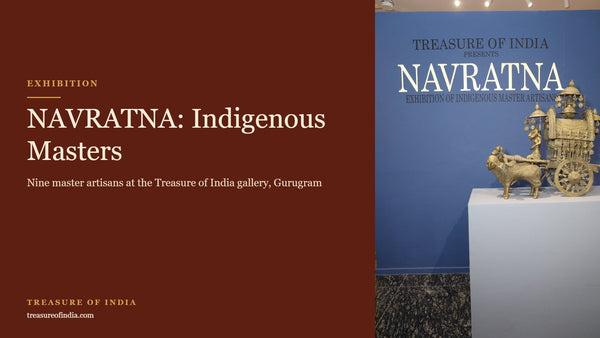
Dhokra is a lost-wax casting craft practised by tribal communities in central and eastern India. The artist shapes the figure in wax over a clay core, covers it with more clay, then pours molten brass in as the wax melts away. Each mould is broken to free the piece, so no two Dhokra elephants are the same. Look for a slightly rough surface, fine wax thread patterns and small variations, which are signs of handwork. Baldev Waghmare, a National Awardee for Dhokra, makes many of our elephant statues. Read more in our guide to Dhokra metal art.
Elephants in Indian Paintings
Each painting tradition draws the elephant in its own way.
- Gond: elephants filled with dots and lines, often beside a tree full of birds.
- Pichwai: decorated elephants in Krishna scenes from Nathdwara, Rajasthan.
- Mysore: royal elephants with fine gold work, linked to the court of Mysore.
- Rajasthani miniature: processions of kings on richly dressed elephants.
- Pattachitra and Sohrai: bold elephants in Odisha scroll painting and in Jharkhand wall art.
- Madhubani: elephants as a symbol of royal blessing in Mithila art from Bihar.


Where to Place Elephant Art
- Near the entrance, facing in, as a welcome.
- In the living room as a main wall piece or on a console table.
- In a study or office, where elephants suggest wisdom and steady work.
- As a pair on either side of a doorway or shelf.
Elephant Art Prices
Elephant artworks at Treasure of India currently range from ₹1,299 for painted key hooks to ₹60,999 for a large Pattachitra, Kandara Hathi and Krishna Leela by Niranjan Maharana. Rajasthani miniature elephants start at ₹1,499 and Gond paintings at ₹2,599. Dhokra brass elephants by Baldev Waghmare currently start at ₹5,990, with large statement pieces higher. Price depends on size, weight of metal, detail and the artist.
Shipping Worldwide
We ship worldwide from our gallery in Palam Vihar, Gurugram. Orders usually arrive in 2 to 3 weeks, and made-to-order pieces need 2 to 4 weeks of crafting first. International shipping is a flat ₹4,000 per order. Shipping in India is free on orders of ₹2,999 and above. Customs duties and import taxes are paid by the buyer; see international shipping, customs and duties. Every piece comes with a signed certificate of authenticity naming the artisan.
Explore More Indian Art
Browse the full elephant art collection, Dhokra metal art and Rajasthani miniature paintings. For more symbols, read about the seven horses painting and the tree of life. You can also book a gallery visit to see the statues in person.
FAQs
What does an elephant symbolise in Indian art?
Wisdom, strength, royalty and good fortune. Elephants are linked with Ganesha, with Airavata, the mount of Indra, and with the goddess Gaja Lakshmi.
Should an elephant statue have its trunk up or down?
By popular belief, trunk up brings luck and joy, while trunk down stands for calm strength. Neither is a fixed rule.
Where should I place an elephant statue at home?
Many people place it near the entrance facing in, or in the living room. Pairs are often placed on either side of a door.
What is a Dhokra brass elephant?
An elephant statue cast in brass by the lost-wax method, made by tribal artisans in central and eastern India. Each piece is unique.
How much does elephant art cost?
Elephant artworks at Treasure of India currently range from ₹1,299 to ₹60,999, depending on the craft, size and artist.